
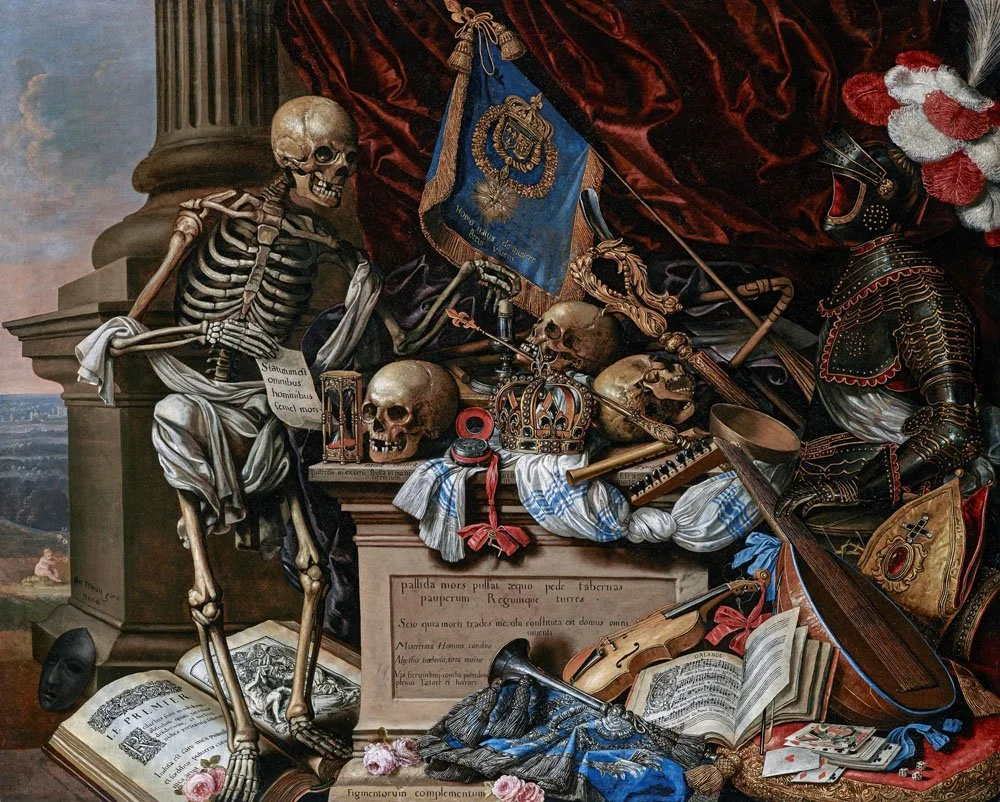
The forces of love and death – opposed but also entwined – permeated European culture from the late Middle Ages into the nineteenth century. Pure love was held up as a human ideal but often yielded to its baser and more easily achieved relative, lust. Both operated under the shadow of the inevitability of death. The ancient Latin phrase “memento mori” – “remember that you will die” – was taken up by Christian theologians, moralists, and artists. Visual artists also declared the message through an abundance of symbols, motifs, narratives, and texts. Some conveyed the idea that an accumulation of worldly power, riches, and honors – in fact, all human endeavor – is vain, without substance, transient, and useless at the hour of death. Sexual desire was arrayed with lust after possessions and lust after glory, but these subjects were often taken up by artists and writers with considerable wit, counterbalancing dour moralizing, and occasionally carrying at least a hint that transcending base desires was the virtue of love.
Through paintings, objects, prints, and illustrated books – both sacred and secular – in the richly varied collection of the Sarah Campbell Blaffer Foundation, this exhibit demonstrates the early-modern preoccupation with living well and dying well.
Curated by James Clifton, Director of the Sarah Campbell Blaffer Foundation, Houston.